
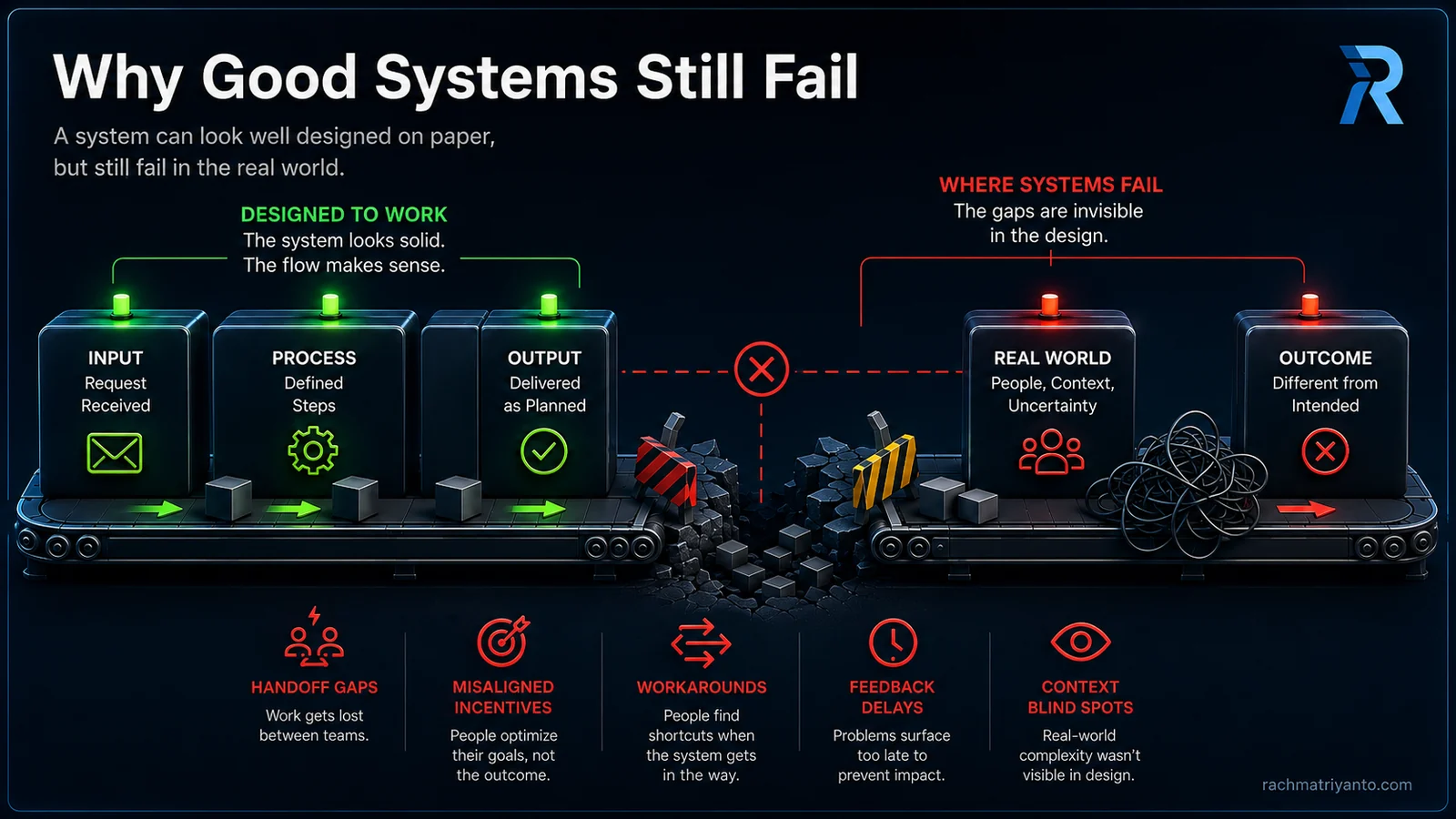
A system can be logically correct and operationally wrong
Good systems are usually designed with a sensible intention. Roles are defined, steps are documented, controls are added, and targets are agreed. On paper, the sequence can look complete.
But a system does not operate on paper. It operates through people who face incomplete information, changing priorities, conflicting incentives, interruptions, workload, exceptions, and time pressure. A design can therefore be logically correct while still being operationally fragile.
A useful test is not only whether every step exists. It is whether the system still produces a good outcome when conditions are imperfect.
A system is not only what the process says. It is what people repeatedly do under real conditions.Working principle
Incentives quietly rewrite the process
People pay attention to what is measured, rewarded, escalated, and punished. When the formal process asks for one behavior but the operating environment rewards another, the operating environment usually wins.
A team may be asked to improve quality while being measured mainly on speed. A manager may be asked to reduce escalations while also being expected to close cases quickly. A technician may be encouraged to document thoroughly while carrying a workload that makes documentation feel like a penalty.
The result is not necessarily bad intent. It is adaptation. The real system becomes the combination of the documented process and the incentives surrounding it.
Key idea
When behavior repeatedly conflicts with the formal process, investigate the system before blaming the people. The environment may be rewarding exactly what the organization says it does not want.
Context is part of the design
A process that works in one environment may not transfer cleanly to another. Geography, skill distribution, vendor capability, customer expectations, data quality, parts availability, and decision authority all change how a workflow behaves.
This is why standardization should define the stable core while leaving room for legitimate context. The purpose of a standard is to reduce unnecessary variation, not to pretend that every situation is identical.
Feedback must reach the rules
A system becomes stronger when recurring exceptions are treated as information. If the same workaround appears repeatedly, it may be telling us that the official process is missing something.
Dashboards can show that a problem exists, but learning requires a path from evidence back into design. Someone has to ask what should change: the rule, the tool, the ownership model, the training, the data, or the expectation.
Without that loop, organizations can become very good at reporting the same weakness every month.
Closing thought
A good system is not one that never encounters exceptions. It is one that handles ordinary work reliably, makes exceptions visible, and learns from them without depending on constant rescue.
The gap between a process that looks good and a system that works well is often found in the space between rules and reality.