
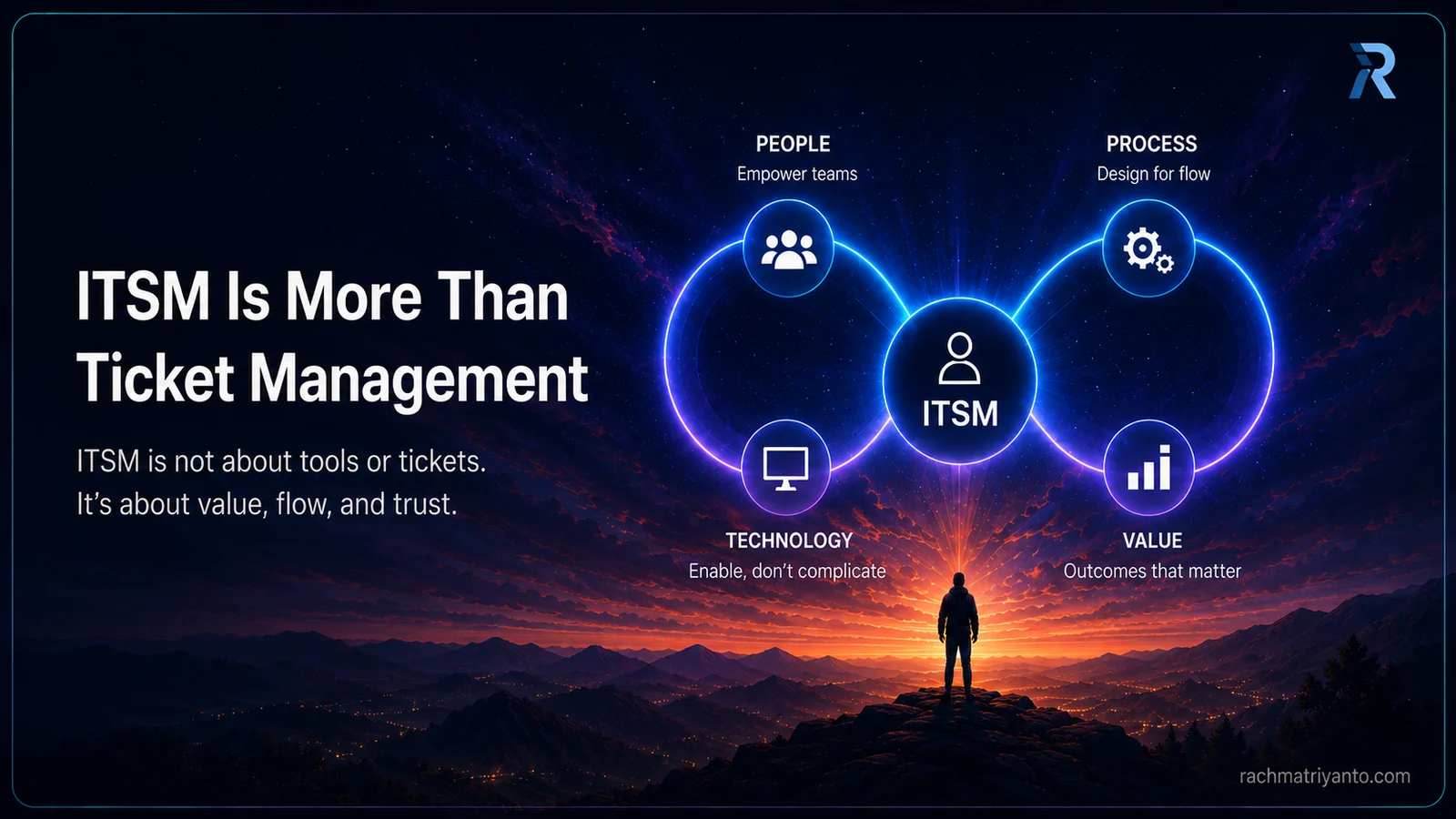
A ticket is a record, not the service
A ticket helps capture work. It can hold a request, an incident, an owner, a status, a timestamp, and a history. That is valuable because invisible work is difficult to manage.
But the ticket is still only a representation of something happening in the real world. A customer needs access restored, an employee needs a device, a business process is blocked, or a system is behaving unexpectedly.
When service management is reduced to ticket movement, it becomes easy to optimize the record while missing the outcome.
A closed ticket can still represent an unresolved service problem.Working principle
The service exists across the whole flow
Reliable service depends on more than the team that receives the first request. Intake quality, routing, diagnosis, authorization, vendor response, technical execution, communication, knowledge, and closure all influence the final experience.
A queue can therefore look healthy while the end-to-end journey is slow. One team may meet its internal target by handing work to another team quickly, while the customer waits just as long as before.
The useful unit of analysis is the service flow, not only the local activity.
Key idea
Measure the movement of work, but also measure the outcome the work was supposed to create. The two are related, but they are not the same thing.
Ownership matters more than motion
Work can move many times without actually progressing. Transfers, reassignments, and status changes create activity, but activity is not the same as ownership.
A good service model makes the next responsible party clear and also makes it clear who remains accountable for the overall outcome when multiple teams are involved.
Every resolved case should improve the system
Service operations generate a continuous stream of learning. Repeated symptoms reveal weak points. Escalations reveal decision gaps. Repeat incidents reveal missing fixes. Customer questions reveal communication gaps.
The value of the ticket therefore continues after closure. A mature service practice uses operational history to improve knowledge, automation, routing, monitoring, standards, and expectations.
Closing thought
Ticket management is necessary, but it is not the destination. The real objective is a service system that makes demand visible, coordinates responsibility, protects the customer journey, and gets smarter over time.
The moment we stop asking only how quickly tickets move and start asking how reliably services recover or improve, the conversation becomes much more useful.